Category: peace

  • There is a diner near my house where I have breakfast every Sunday.  It is the unofficial gathering place for the neighborhood, the kind of place where you’re greeted by name — not only by the owner, but by the guys who sit on the same stools at the counter, everyday. 

    The food is standard diner fare, but the donuts!  Homemade, with a heavenly scent of cinnamon, a slight crunch to the outside, warm, soft, inside.  Perfection. 

    And so, when someone posted something on Facebook about the diner, I commented “The best donut you’ll ever have.”  Thus started the great donut war. 

    Someone disputed my claim, writing, “I’ve had better donuts from the supermarket. Overrated.”  Supermarket donuts?  What kind of nut was this guy? I shook my head and said, well, it’s a free country, and that means you are free to be wrong, even about donuts.  

    I let it go, and got on with my day.  He did not.  Every time someone else posted about their love of the donuts, he responded again.

    Why?  Was he one of those people who’s proud of fighting the donut pastry-archy?  Was he nursing some longstanding donut grudge against this diner? Didn’t he have anything better to do?  Didn’t he have someone in his life who could say to him, “Let’s go for a walk and leave all this donut talk behind us?” Whatever, he seemed to have invested a whole lot of himself in this discussion.

    Of course, this is the nature of social media. In that universe, you are expected to have an opinion about everything, and the more strident the better.  And while this is plenty healthy for those who profit from stirring up strife, disagreement, hot takes, and general crankiness, it is not healthy for the rest of us. 

    There are things we should be passionate about like injustice, suffering, kindness, beauty.  And there are places where we should express that — although I contend social media isn’t one of them. I don’t think anyone has had their mind changed by a hot take on TikTok.  

    Even when we express our views on topics worthy of our time and mental energy, can we do it winsomely, respectfully, with enough humility to leave room for the possibility that we just might be wrong?  St. Paul was someone well acquainted with conflict, bad blood, name-calling, and everyone pointing fingers at the other side and crying “heretic!”, Thankfully he didn’t have to do it in the cauldron of social media.  (Can you imagine the flame wars he would have been in?)

    In Romans, Chapter 12, Paul had wise words for trolls of his time:  

    Repay no one evil for evil, but give thought to do what is honorable in the sight of all. If possible, so far as it depends on you, live peaceably with all.”  

    So far as it depends on you … you can choose peace.  Still, sometimes you will find yourself in the middle of a fight about something that really matters. Paul says, engage if you must, but “do what is honorable in the sight of all.”  Other times, it will be within your power to live peaceably with all. 

    He goes on to say, “Beloved, never avenge yourselves, but leave it to the wrath of God, for it is written, ‘Vengeance is mine, I will repay, says the Lord.’” 

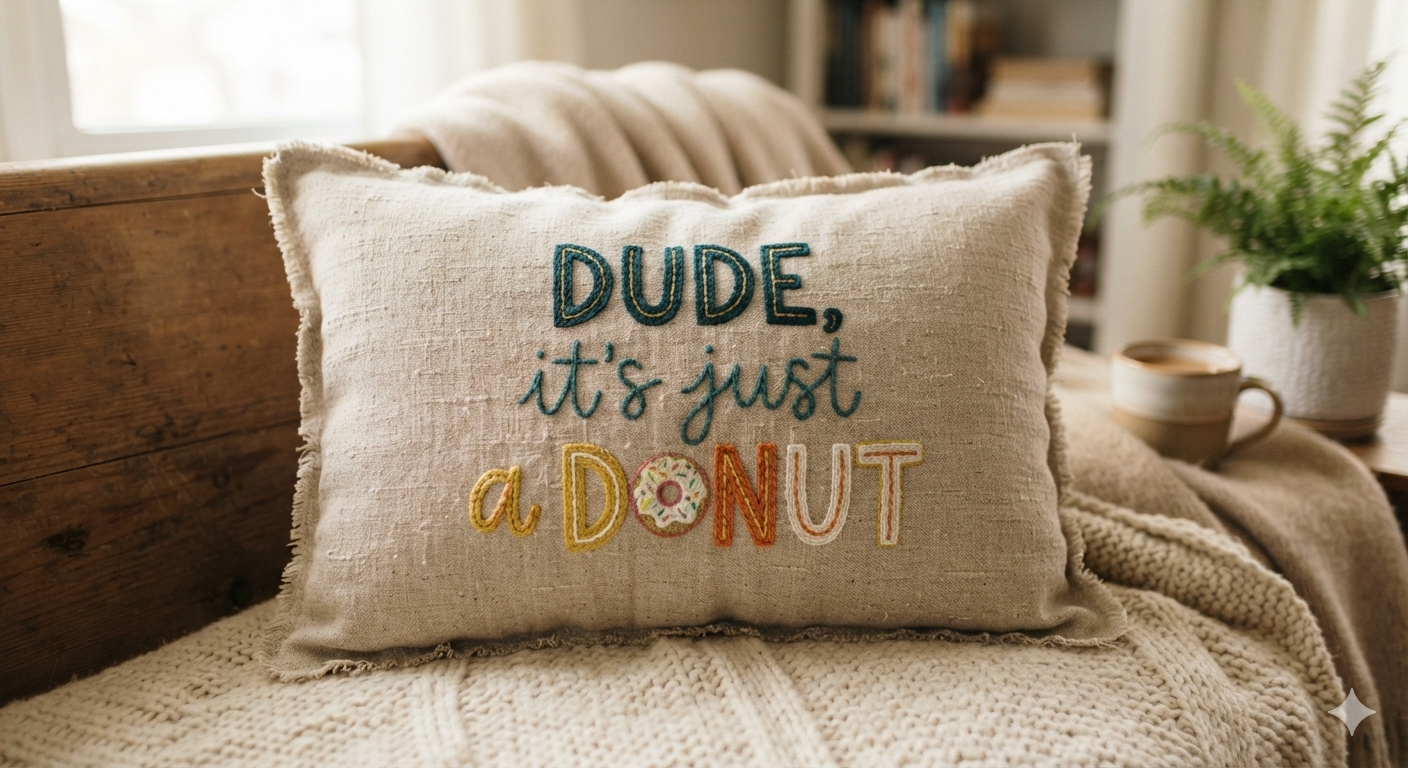
    Perhaps, when God comes to make all things right, my donut friend will be vindicated in his contrarian view on breakfast pastries.  But until then, I say to him — and to myself, when I feel drawn into some silly controversy — dude, it’s just a donut. 

  • Imagine That

    Photo credit: Laura LaSpalluto

    With the late afternoon sun at just the right angle, the Creation of the World, rendered in stained glass, had never looked more beautiful. I have worshipped in this space many times, with many of the same people that are here today for an interfaith worship concert. I know that this institution and the people in it believe the church is a force for good in the world, a light in the darkness. That’s why I was so unprepared for what happened.

    In this sacred space, a lampstand of the second largest Protestant denomination in the U.S., people got to their feet and cheered the notion that what was wrong with the world was religion.

    The song that elicited this Standing O was John Lennon’s “Imagine.” The soloist invited us to “Imagine all the people, living life in peace.” How we ache for that, when the city of Aleppo is reduced to rubble and its citizens dead, starving or in exile. Dare we hope for a world that “will be as one” when terror and mayhem are striking ever closer to home? We wake every day to a cacophony of political distrust and acrimony. It’s no wonder we hear hope in Lennon’s words and we stand and we cheer. Yes. This is what we want. This is what we hope for. We want it so badly that it’s easy to only hear the words of love and peace.

    But there are other words that get lost in the sentimental haze of this beloved anthem. They are the words that show us Lennon’s way to this utopia:

    Imagine there’s no heaven …
    Imagine there’s no countries …

    And no religion, too …

    We can have the peace we long for if we could just be free from the corrupting forces of political and religious institutions. No countries, no religion, no possessions: this is how we can be selfless, loving and living in pure harmony. This is the thoroughly modern worldview that says people are basically good, and if they’re not, we can blame the government, or the church, or economic systems.

    The Christian worldview is very different. Humans are a paradox. We are created in the image of God and declared good by Him, as depicted in the stained glass windows that were the backdrop for this afternoon’s exercise in irony. Yet at the same time, we carry within us the potential for rebellion, selfishness, violence and greed. In other words, we have the capacity for sin.

    In this view, we can acknowledge that political and religious institutions have brought pain into the world. Yes, greed keeps some fat and happy while other starve. But these are the result, not the cause of human depravity and violence.

    There is disorder in this world that political and religious institutions neither foster by their presence, nor prevent by their absence.

    There is disorder in this world because there is disorder in us, and when that disorder is allowed to flourish, we have Aleppo and Orlando. We have modern day slavery and gun violence and every form of suffering a depraved mind can invent.

    Ironically, “Imagine” — Lennon’s paean to basic human goodness — reached #1 in the U.S. after his death in 1980. The sources of violence and discord Lennon cites in his song — country, religion, greed — are not what motivated his murder and their absence wouldn’t have prevented it.

    No, for that we have to look beyond the easy answers of oppressive systems into the human heart — even into our hearts.

    The Christian worldview says that there is a persistent force of evil at work in the world, a force we can either resist or surrender to. To contend that the only obstacles to the peace we long for are political, economic and religious systems leaves us dangerously vulnerable to the most formidable obstacle of all: Sin.

    Like John Lennon, the prophet Isaiah had a vision of a world without conflict and pain. Unlike Lennon, in Isaiah’s vision, the root cause of all the world’s pain will be dealt with by a savior with the power to do what we cannot. Our savior, in his life, death, and resurrection began the work of making us selfless, loving and able to live in peace with one another. And in his return, he will complete that good work he has begun.

    “A shoot will come up from the stump of Jesse;
        from his roots a Branch will bear fruit.

    The Spirit of the Lord will rest on him—
        the Spirit of wisdom and of understanding,
        the Spirit of counsel and of might,
        the Spirit of the knowledge and fear of the Lord—
     
    and he will delight in the fear of the Lord.
    He will not judge by what he sees with his eyes,
        or decide by what he hears with his ears;

    but with righteousness he will judge the needy,
        with justice he will give decisions for the poor of the earth.
    He will strike the earth with the rod of his mouth;
        with the breath of his lips he will slay the wicked.

    Righteousness will be his belt
        and faithfulness the sash around his waist.

    The wolf will live with the lamb,
        the leopard will lie down with the goat,
    the calf and the lion and the yearling[a] together;
        and a little child will lead them.
     
    The cow will feed with the bear,
        their young will lie down together,
        and the lion will eat straw like the ox.
                                                   (Isaiah 11:1-7)

    Imagine that.