Category: Uncategorized

  • Lost and Found


    When we last left our unlikely pilgrim, she was contemplating the nature of sacrifice in a cow pasture in Spain. Inspired by Romans 12:1, she set out to “present (her) body as a living sacrifice, holy and acceptable to God,” by walking the last 80 miles of El Camino de Compostela, an ancient pilgrimage route. Her romantic notions of noble self-sacrifice were punctured by pain and exhaustion, and she began to wonder: Just what was God up to here?

    This is how my last day on the Camino began: My Pilgrim’s Passport went missing.

    Scan 161870017 (1)

    The pilgrim’s passport is a booklet in which you collect stamps at stops along the way, everywhere from charming chapels in the woods to bars and hotels. At the end of your Camino, you present the passport at the Cathedral of Santiago de Compostela, and you receive your compostela, a spiritual diploma that attests to your accomplishment.

    On that last day as we prepared to walk the final miles of our Camino, my passport was nowhere to be found. After a week of carefully guarding it and diligently getting it stamped, it was suddenly missing. I tore apart our backpacks, our suitcases and every last pocket on my many-pocketed hiking pants. It was just gone.

    I was flustered. Mystified. Angry. After all this, after pushing myself beyond exhaustion day after day, now, I wouldn’t even get my certificate? Are you @$%&* kidding me?

    Like a demented drill sergeant, words of anger and frustration barked out the cadence for my final march to Santiago:

    I. Can’t. Believe. This.
    I. Can’t. Believe. This.
    On and on I stomped, furious that after my fantasies of a Camino filled with spiritual revelation had already been dashed, even this small pleasure of getting that certificate would be denied me.

    And then I swear I heard God laugh.

    I heard Him say, “Really? Is that what this has been about — a certificate, a report card, a Gold Star?”

    And then I laughed. A rueful, I-can’t-believe-what-a-dope-I-am, laugh.

    You see, the only really unbearable pain of the week wasn’t physical. No, the worst pain I had on my Camino, the pain that made me cry hot, bitter tears, was my own embarrassment and shame.

    Now, I had no illusions about being the first to reach our meeting place each day; neither did I believe I would come limping in last. I figured I would be a respectable middle-of-the-pack; a good solid B-.

    That’s why it was so hard to watch pilgrim after pilgrim stride past me in what (seemed to me) to be pain- and fatigue-free spiritual ecstasy, while I struggled. And why, when I did come limping in last one day, I didn’t hear the love and encouragement in my friends’ cheers; what my distorted ears heard was pity and judgment.

    You know how it is. When you’re tired, or sick or discouraged, you are exquisitely vulnerable to thoughts that flow from old, ulcerated wounds. The worst pain on my Camino was knowing that my weakness and failure were on display for all to see, a dread that has thrummed throughout my life. And then, to not even get my compostela — my gold star — well, that was just more failure than I could bear.

    Although not in the way I imagined, God showed up on my Camino.

    I so wanted to offer Him a perfect gift in this pilgrimage; instead He honored my gift in its imperfection.

    I wanted to achieve and get my gold star; He wanted to release me from the tyranny of achievement.

    I wanted to be alone in my shame; He provided loving friends to surround me.

    God chose this moment, when I was at my weakest and most worn out, to ask, “Are you tired of this yet? Are you ready to let it go?”

    Yes. Yes I am.

    God chose this moment to ask, “Are you ready to believe that you are of infinite worth for no other reason than you are my beloved daughter?”

    Yes, I am.

    This was seismic stuff. And it wouldn’t have happened if I hadn’t lost that blasted passport. I believe that in His infinite mercy — and sense of humor? — God hid my pilgrim’s passport from me so I could come to this moment. (I say this because after God and I had a good laugh at my ridiculous fit over losing the passport, I suddenly knew where it was — in a hidden pocket of a jacket that was packed in my suitcase. And sure enough, when we got to the hotel in Santiago, there it was.)
    “Present your body as a living sacrifice, holy and acceptable to God,” (Romans 12:1). This was my plan for the Camino.

    The verse that follows it (Romans 12:2) was God’s plan:

    “Do not be conformed to this world, but be transformed by the renewal of your mind, that by testing you may discern what is the will of God, what is good and acceptable and perfect.”

    Yes.  It would take a renewed mind to reject the world’s definition — my definition — of success and failure, worthy and unworthy.  It takes a transformed mind to begin to see what God deems good and acceptable and perfect.  Those last steps of my Camino were just the beginning of my pilgrimage.

  • Resurrection Monday

    On the morninDSC_0079g after a lovely Easter dinner, I faced a kitchen full of dishes, pans, serving platters and glassware to put away. I put on some music and got to work. When I was done, I was delighted that the kitchen had been restored to order. I said with great triumph (to a cat that looked singularly unimpressed), “You’d never guess that anything had happened here.”

    Household order aside, this is not what you want to be saying on the day after the Resurrection. Christ wasn’t raised from the dead so we could pack him away with the good china and Easter baskets until next year. Easter is about our resurrection life, too.

    In Surprised by Hope, N.T. Wright says that if Lent is when we weed the garden, Easter is when we plant and nurture.

    “But you don’t want simply to turn the garden back into a neat bed of blank earth. Easter is the time to sow new seeds and to plant a few cuttings. If Calvary means putting to death things in your life that need killing off if you are to flourish as a Christian … then Easter should mean planting, watering, and training things up in your life that ought to be blossoming, filling the garden with color and perfume and in due course bearing fruit.”

    We are invited to participate in the new creation that came into being on Easter Sunday. In the first creation God’s words manifested in visible, tangible things — stars, oceans, plants, animals, people. The creation that took place on that first Easter was largely invisible, though no less miraculous. What was created when Jesus emerged from his garden tomb was the hope that death was not the end. What came to being was the promise that the Holy Spirit would animate and give us power to live new and different lives, just as He did for the Apostles. Where once they were fearful, now they were bold. Once they were the students, they were now the teachers. They were now the healers, forgivers and welcomers to sinners. This was their resurrection life and it can be ours, too.

    It’s Resurrection Monday. The world outside my window looks the same as it did last week. The news on CNN is, lamentably, more of the same. But In the spiritual realm, everything is new. God is calling me to join Him in His new creation, to take the daffodils from my Easter dinner table and plant them in the garden. He is inviting me to live and love in this world, to create beauty and do good, knowing that there is an unseen reality where love and justice reign, and where death is never the end.

    It’s Resurrection Monday.  What will you plant? 

  • To Die For

    In the courtyard of Caiaphas' house, Jerusalem
    In the courtyard of Caiaphas’ house, Jerusalem

    Have you ever watched someone you love when you think they’re not looking and think, “Yes, if it would mean your happiness, if it would save your life, I’d die for you.” 

    Maybe you have believed so strongly in the righteousness of a cause that you were willing to risk your very life for it. Some powerful images come to mind: the lone protester defying tanks in Tianamen Square, civil rights marchers facing snarling dogs in Selma, or a line of martyrs kneeling on a beach, seconds before they are beheaded for their faith. I am in awe of such people.

    Popular culture is full of epic love stories and tales of heroism that demonstrate love and commitment so strong that it would pay any price to protect and ensure justice for the innocent.  These stories give us goosebumps and allow us to believe in the goodness of humanity.  They are beautiful stories, but they are not the story of Good Friday.

    Like all of Jesus’ life, the story of Good Friday turns a familiar narrative upside down:

    in this story, the Hero doesn’t sacrifice himself to save the innocent; he dies to save the villains.  Think Batman dying to save The Joker and you’ve got some idea of what happened on Calvary.  

    This is how Paul’s Letter to the Romans puts it: 


    We can understand someone dying for a person worth dying for, and we can understand how someone good and noble could inspire us to selfless sacrifice. But God put his love on the line for us by offering his Son in sacrificial death while we were of no use whatever to him. (The Message)


    We can understand dying for someone worth dying for. But what about the person who has hurt you deeply?  Would you give up everything so that person could live a life of freedom and peace?   What about the parade of evildoers that come into view every day:  terrorists who murder and rape, child abusers, financial criminals, politicians who make the veins in your neck pop and bile fill your mouth. Any volunteers to die in their place? Anyone?  

    Maybe when I’ve mastered Jesus’ command to bless those who harm me, I can tackle something more challenging.  But for now, my answer is:  I would die for my husband. I would not die for Donald Trump.  But Jesus would and Jesus did.

    And it wasn’t just for some abstract multitude of Sinners. What Jesus did was also very specific, very personal, and beyond any human calculus of good or bad, worthy or unworthy. Before He died for All of Humanity, he willingly died for one human: Peter, his weak and cowardly best friend.  The intimacy of his sacrifice is often lost in the Grand Story of the Passion. 

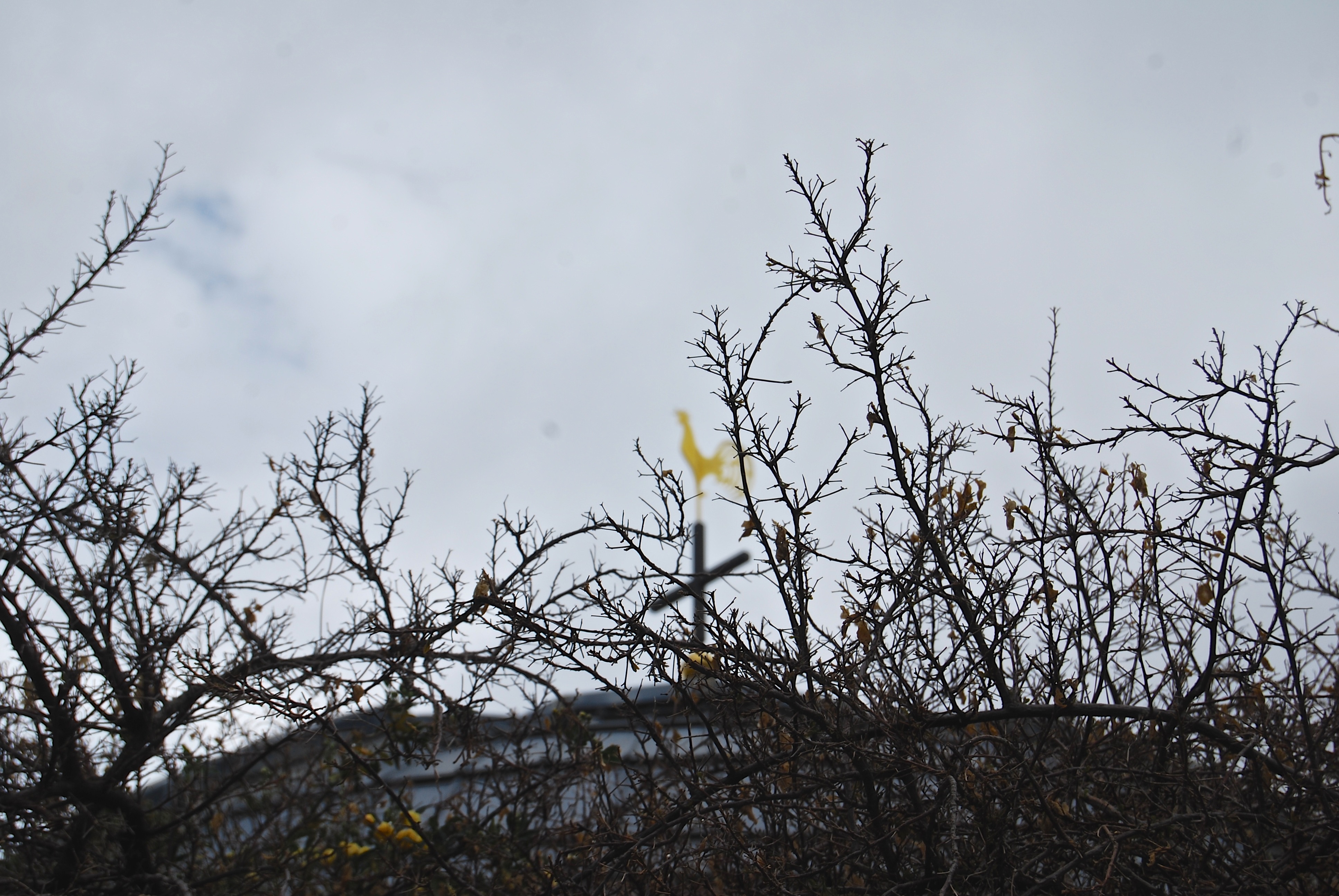
    It all played out in a courtyard, where a cold wind blew and a rooster crowed.

    There Peter stood by a makeshift fire that couldn’t warm the spiritual shiver slicing through him. Just a few hours before, he proclaimed with great bravado, “Even if I must die with you, I will not deny you!”  Those words mocked him now; with each denial, he grew colder and more ashamed. The rooster crowed, and his despair was complete. Bad enough he had failed so miserably, but His Lord knew he would and knew he did.

    He knew he did because Jesus was near, just beyond that courtyard in a dark, damp pit, utterly alone. Jesus heard the rooster crow and He knew it happened exactly as He said it would.  Peter — His comrade-in-arms, who promised to defend him to the end — had failed him miserably. His friend has broken his heart. And still, He allows himself to be tortured and humiliated and mocked, not only for the sake of all sinners past present and future, but also for this sinner, for this one, weak, flawed man who had abandoned Him.  

    Christians often talk about having a personal relationship with Jesus.  If we’re anything like Peter, that means there are times we’ll boast about our faith and our fidelity and in the next breath, lie to save our own skins.  It means that, for all our confidence in our own goodness, we will falter and break His heart.  For us, in our humanity, this would seem to be a deal breaker.  But Jesus knows that our human frailty, while painful to Him, is exactly why He had to step into the breach.  

    This Good Friday, let us not be satisfied to say that Jesus’ sacrifice was grand, sweeping and for the salvation of all.  Let us stand in the courtyard with Peter, shocked at the pain we have visited on our Lord.  Let us crouch in the pit with Jesus, the Hero of this upside-down story, whose sacrifice for the unworthy was and is intensely personal, emotionally costly and for the salvation of one.  

    And let us remember that Peter’s story didn’t end in that courtyard and neither does ours. God will do for us what he did for Peter:  Forgive us.  Give us resurrection life, fueled by the Holy Spirit.  Give us grace to heal, reconcile, love, maybe even to sacrifice ourselves for those we consider “unworthy.”  

    More from Paul’s Leltter to the Romans:

    “We throw open our doors to God and discover at the same moment that he has already thrown open his door to us. We find ourselves standing where we always hoped we might stand—out in the wide open spaces of God’s grace and glory, standing tall and shouting our praise.”

    Not cowering in that courtyard — but standing tall and shouting our praise in the wide open spaces of God’s grace and glory.


  • True Love is a Folded Newspaper

    DSC_0014

    If you dare to open a newspaper, watch TV or venture into a store in the frenzied run up to Valentine’s Day, you’ve probably run the gift gauntlet between the sublime (anything with diamonds) to the ridiculous (silly silk boxer shorts printed with large red hearts). Perhaps you’ve had the overwhelming feeling of shame that comes from believing that if you don’t get or give the perfect gift, or arrange The Bachelor’s idea of a romantic dinner, you have failed at this love thing.

    To hear the world tell it, Valentine’s Day is the Ultimate Love Litmus Test,

    whether you’re in the early stages of love or have been together so long your wedding video is on VHS. The size, cost, or intimacy of the gift is supposed to tell you something about the relationship. Did he give you jewelry? He’s a keeper. A toaster? Generally, not a good sign, although I once got a cordless drill for my birthday and I was thrilled. Every gift, every card, every part of The Valentine’s Day Experience is scrutinized for clues and hidden meaning about the relationship. That’s a lot of pressure on something so delicate as love.

    Valentine’s Day can be particularly tricky if you’re married to someone who chafes at being told to be romantic on command by Hallmark and 1-800-Flowers. My husband is, by nature, a generous and caring person; he just doesn’t like having that generosity and care dictated and scheduled by someone else. When the whole world has gone Valentine-mad, it can be easy to forget the flowers he brings me for no reason or the fact that the cat that he wasn’t thrilled about adopting is nevertheless sitting in my lap. No one ever asks me about those things. Instead, people want to know, “What did he get you for Valentine’s Day?” What I want to say is, “Let me tell you about the time he handed me a folded newspaper.”

    Like most couples, we have different ideas about how things should be done. For instance, how to read the newspaper. We get three papers a day, and I read them in the same order every day. First the local paper. Then the New York Times. Then the Wall Street Journal over lunch. With each paper, I begin with Page 1 and read in the order in which the editors put it together. Being a writer, and a respecter of authority, I figure that a professional put the paper together in this particular way for a reason, and that’s good enough for me. In other words, I read the paper the right way.

    Now — how shall I say this delicately? — my husband is a newspaper anarchist. He’ll read sections out of order. Within sections, he’ll pull pages out of sync. He’ll even mix and match from one paper to another. You can imagine what I think of this.

    Then one day, this happened: We were riding on a crowded train together and found seats far apart from each other. I took one paper, he another to read on the ride into the city. When we got off the train, we exchanged papers. The paper he handed me was in pristine condition: perfectly folded, sections in order, not a page out of place. There was only one explanation.

    “Why didn’t you read your paper?” I asked.
    “Oh, I read it.”
    “But it’s in perfect order!”
    “I knew you were going to read it next and I know how you like it.”

    I just about cried, right there on Track 24 of Grand Central Station. He folded the paper for me, even though my rigidity is as annoying to him as his anarchism is to me. It was a trivial thing — a tender, loving, selfless, trivial thing. That day, hundreds of commuters brushed past us on that platform, not knowing that the Ultimate Love Litmus Test was unfolding right before them.

    I will spend this Valentine’s Day with a man who folds the paper for me.

    Don’t get me wrong. I like getting jewelry. I love roses (just not red). I even like flowery cards and candlelit dinners. And I did love that cordless drill. He gives me all these things, maybe not on proscribed days, but according to his own Romance Calendar. But as much as I love those things, I don’t want my head to be turned by them. I want to hold fast to the words of St. Paul, who couldn’t have had newspapers in mind when he wrote this, but who nevertheless lays down the challenge of loving God’s way:

    “Love is patient and kind; love does not envy or boast; it is not arrogant, or rude. It does not insist on its own way; it is not irritable or resentful. It does not rejoice at wrongdoing, but rejoices with the truth. Love bears all things, believes all things, hopes all things, endures all things.”

    This kind of love is more costly than anything Tiffany’s has to offer. It can be elusive and sometimes downright impossible. It asks us to think less of ourselves and more of the other, and not just when we’re feeling all lovey and besotted with them. Especially when we’re not feeling lovey and besotted with them. When, by the grace of God, we manage to be patient and kind, when we do not insist on our own way (even though we’re clearly right!), when we bear all things, believe all things, hope all things, endure all things— well, then we get a glimpse of True Love. Not Hallmark love. Not Hollywood Rom-Com love. Not even Top 40 Romantic Ballad love.

    True. Love.

  • Gimme Peace!

    One of my favorite scenes from one of my favorite movies has Robert Duvall shouting at God: ”Gimme peace!” 

    I feel like the whole world is shouting that lately: “Give us peace! Give us peace!” Of course, opinions about how we achieve this run the gamut: more gun control, less gun control, accepting refugees, banning refugees, direct engagement, isolationism. Whatever the means proposed, the end is the same: Give us peace.

    Here’s the good news: In just two days, Peace will come. Maybe not the way we envision, but Peace will come. In just two days, the Prince of Peace will once again enter a world as broken, violent and messy as the one on the first Christmas to remind us that Peace is not a political solution. Peace is not a military solution. Peace is not something we can legislate, manufacture or create. Peace is a person. And until we understand that, the peace we are desperate for — in our world, in our communities, in our homes, in our hearts — will elude us.

    The Bible talks a lot about peace, but only sometimes as the absence of war or conflict. Most of the time, the Bible’s idea of peace — Shalom — has to do with the human heart. It takes several words in English to capture it’s meaning: Integrity. Wholeness. Satisfaction. Rest. Healing. Serenity. Fulfillment. Harmony in relationships, with God and with each other. In short, shalom is everything God wants for us, and everything only He can offer us.

    Now, this hasn’t stopped us from trying to find it elsewhere. The Bible also talks a lot about how we look for shalom in all the wrong places. Adam and Eve were the first to turn from God, longing for something more, something else to satisfy them, but they weren’t the last. We still can fall into the trap of wanting to be like God, of thinking that we can make ourselves and our world secure, happy and whole apart from Him.

    When we count on ephemeral things for eternal peace in our hearts or our homes, we will be disappointed every time. When we think that the right legislation or military strategy or social policy will by itself bring peace or justice to our world, we will fail and never understand why.

    Peace isn’t a concept, an idea or an abstraction. Peace is Jehovah Shalom — the Lord is Peace — and we celebrate His coming, past, present and future.

    766fc8c0e27e59ba371384606e6ae651

    May wholeness be with you this Advent and always. May healing be with you. May tranquility and serenity in the face of trials be with you. May rest and fulfillment be with you. May you allow Peace personified to make you whole. May this be the beginning of peace in our hearts, in our homes, our churches, our cities, our country, our world. Shalom.

  • The God Who Will Come

    Sometimes I get discouraged. I think whatever needs saying about a particular subject has already been said. And I’m sure that its been said in ways far more persuasive, incisive, poetic, amusing, enlightening and inspired than anything I could offer.

    Sometimes, I’m right. Yesterday, I heard a brilliant sermon on what would have been my topic for this week: Advent/The God Who Will Come. The preacher, Rev. Jacky Gatliff, simply and powerfully explains why Christ’s return gives us reason to hope, even here and now, during this most unsettled Advent. I couldn’t improve on it in any way, so I encourage you to listen to it here. If you already heard it yesterday, listen again. It’s that good.

  • Laura to Daily News: Drop Dead

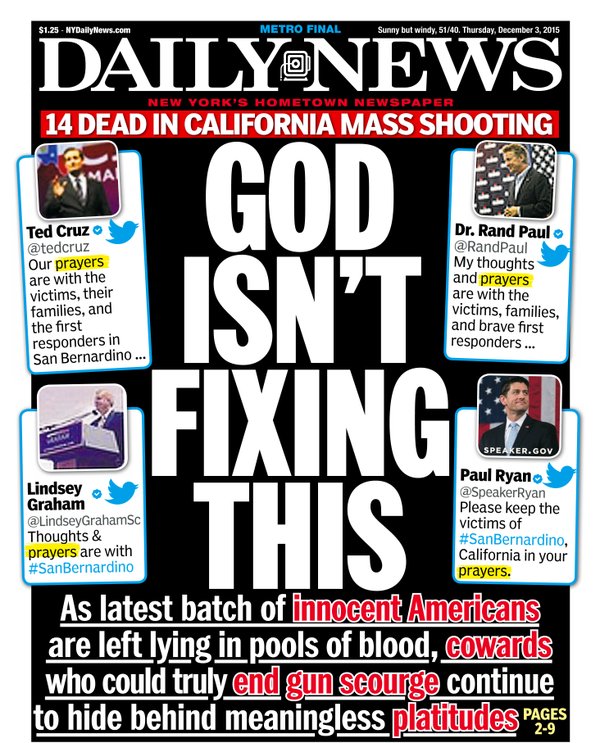
    I grew up reading the N.Y. Daily News, “New York’s Hometown Paper.” Its the paper my Dad brought home from work, the paper I cut articles out of for my “current events” class in elementary school.  It was the only newspaper I knew until I got to my college-prep junior high school, where they made you subscribe to the New York Times. (So much more appropriate for us “intellectually gifted” Hunter girls.) I even worked for a time as their public relations person. And I confess to reading it still on my occasional train rides into the city. So it pained me to write that headline.
    But it was the first thing that came to mind when I saw their headline on this morning’s front page.

    CVRBkkRWUAAcuHJ
    The News’ front page screams our fear and frustration that mayhem has once again been unleashed on our soil, where we once felt safe. I’m OK with that. It ridicules the oft-repeated, empty phrase “Our thoughts and prayers are with you . . . “ intoned by countless politicians, in the wake of various tragedies. I’m with them on that, too. Whenever I hear anyone say that — and it has slipped into our everyday speech like a thief in the night — I cringe. It sounds like you’re saying something comforting, soothing and caring without really saying it. First, I can’t stand the passive tone — we don’t want to be so bold as to say “I’m praying for you” — that would be too in-your-face religious, and you know how our culture feels about that. And I can’t help thinking that “thoughts” are thrown in just in case the speaker or listener wouldn’t welcome prayers. If I were grieving, I’d rather have someone say nothing than something so weasly, but that’s just me. Whatever happened to “My condolences”?

    So, I have no issue with them calling politicians to account for offering us this verbal pablum when what we need is muscular action. But the headline — oh that headline — is an accusation, a taunt, a declaration that prayer is useless. Worse than useless, it makes us complicit in evil because it relieves us of our responsibility to act. (Just an aside here. All the politicians they quote are Republicans. Am I to assume that the prayers of Democrats, who just as often cite the offending phrase, are welcomed?)

    So, Daily News, my old friend, I’m going to keep praying. I’m going to pray that people in power — on both sides of the aisle — will have the guts to do what is right in God’s eyes, and not just about gun control.   I’m going to pray that God will comfort his people. I’m going to pray that the media shows restraint and however tempting it is, avoids inflaming our worst thoughts and actions.  I’m going to pray that God shows us how to “fix it” and that evil will be defeated in my heart and the hearts of those who wish me harm.

    Years ago, I had a friend who was doing “street evangelism” and she asked someone if she could pray for him. He said, “No, I don’t believe in that stuff.” “That’s okay,” she said, “I do.”  

  • The God Who Came

    images

    We are no longer in Ordinary Time. We have entered the season of Advent, and all around me I hear calls to hope, to anticipation, to stillness. I know that I am supposed to mirror the prayerful waiting, the confident expectation of God’s deliverance that the prophets Anna and Simeon so beautifully embody, but this year, my spirit is drawing me elsewhere.

    For Christians, Advent condenses into four weeks what Israel had experienced for centuries: waiting and longing for God to break in, for God to keep his promise of salvation. Generation after generation prayed, waited and wondered, “When, God, when?”

    The thing is, I do know when and how and who and where and even why God finally set in motion his plan to redeem the broken world. And somehow that is making it hard for me this year to muster the appropriate Advent attitude of hopeful, reverent waiting.

    What I have been contemplating is how Advent reveals three aspects of God: The God who Came, the God Who Comes and the God Who Will Come. Each of these asks its own questions and presents its own challenges to how I live my life. This week, we consider the God Who Came.

    In commemorating The God Who Came, we remember the beautifully mysterious story of how God broke into history by becoming a baby. We retell the stories of Elizabeth and Zechariah, of Mary and Joseph, of angels bearing news of impossible pregnancies and the coming of the Savior. We marvel at what God did in that time and place, with these people who are as familiar to us as our own family. Young, faithful, brave Mary. Loving, loyal, obedient Joseph. The shepherds, the angels, the magi and the evil King Herod. Like all good family stories, we tell stories of the God Who Came lovingly, reverently, nostalgically.

    The problem is, it can be easy to relegate the story to Advent Past, leaving my tidy, 21st century life untouched. Don’t get me wrong — I love the stories of Advent Past. But I don’t think they are meant to stay safely boxed, to be taken out once a year, like the nativity on my mantle. When all the comforting nostalgia is put aside, what difference does it make to me here and now that God Came?  In Luke’s Gospel, we hear the story of a demon-possessed man, living in the tombs in the hills of the Decapolis, and his encounter with Jesus:

     “When he saw Jesus, he cried out and fell at his feet, shouting at the top of his voice, “What do you want with me, Jesus, Son of the Most High God?” (Luke 8:28)

    Unlike many who were presumably “in their right minds”, this tortured soul recognizes Jesus for who He is. And he knows that he will not emerge from the encounter unchanged.

    “What do you want with me, Jesus, Son of the Most High God?”

    This question echoes through the ages, from the tombs of the Decapolis to the cul-de-sac I live on. It reminds me that the mission of The God Who Came is at once universal and intensely individual. God came and taught and loved and laughed and cried and suffered and died and defeated death. And He meant it to change the world. And He means it to change me.

    “What do you want with me, Jesus, Son of the Most High God?”  This Advent, instead of quietly anticipating the arrival of The God Who Came, I find myself at His feet, wondering:  Where do you want me to go? Who do you want me to serve? What will you ask of me?   Like Mary during the very first Advent, I find I have many things to ponder in my heart.


  • Who Do Atheists Thank on Thanksgiving?


    ... Or a lesson in semantics in time for Turkey Day

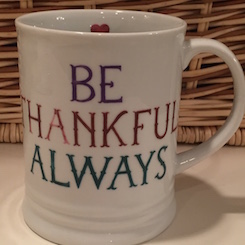
    Being a writer, I naturally wonder about the semantics of Thanksgiving. Thankfulness or gratitude requires an object. When someone holds the door for me, I thank them. I don’t do this if I open the door and walk through it myself. When someone gives me a present, I thank them; I didn’t thank myself this morning when I bought myself a new watch.

    So, to my word-obsessed mind, the question naturally arises, “Just who are we giving all those thanks to?”

    Or, to put another way, who do atheists thank on Thanksgiving?

    The first Thanksgiving was a harvest festival, and as such, was a way to give thanks to God for His provision. For people who believe, as Scripture says, “Every good and perfect gift is from above,” tomorrow will be a day of real Thanksgiving to the God who cares for them.

    But I have noticed that often when people (those of faith and otherwise) say they’re thankful, what they really mean is they’re happy or pleased. As in “I’m so thankful that I bought my turkey last week when it wasn’t crowded.” Or, “I’m sure grateful Aunt Sally didn’t bring that jello mold this year.”

    IMG_0974

    Thankfulness is focused on the source of the blessing; happiness on the receiver.

    Tomorrow, at our Thanksgiving feast, we will go around the table and one by one, say what we are thankful for. When it is my turn, will I remember the giver of the gift, or settle for the pleasure it gave? Will I be thankful, or merely happy. Will you?

  • Seeing Red

    Social media has been abuzz the last two days over coffee cups.

    That’s right, coffee cups. Specifically, Starbucks’ “holiday” coffee cups, which this year are plain red. No Merry Christmas. No Happy Holidays. No reindeer, snowflakes or jingle bells. Someone posted a video online railing against them for removing all references to Christmas and accused them of “hating Jesus.” The mainstream media are reporting that Christian groups are calling for a boycott, when in fact, no “group” has done so. I think this whole kerfuffle tells us more about the disproportionate power of one cranky guy with a cellphone video than it does about some grass roots, widespread outrage that a coffee cup doesn’t say Merry Christmas on it. I also think it speaks volumes about media and our culture’s image of who Christians are, but that’s a story for another day.

    Still, it got me thinking. It doesn’t bother me at all that a commercial establishment isn’t wishing me Merry Christmas or Happy Hannukah or Joyous Kwanzaa. In fact, I kind of like it. The “holiday season” as we are now to call it, has become an unrecognizable mash up of traditions, beliefs and customs of these three holidays.

    The only thing they have in common is gift giving, which is I suppose why retail is so invested in celebrating and promoting them. These December holidays celebrate different things and mean different things, and yet by accident of timing, find themselves squeezed into seats in the middle row of an airplane, sharing armrests uneasily, on a very long flight.

    They do have one other thing in common. They all have an element of joy and love, and so I guess it’s natural to want to acknowledge this to people you encounter during this time. But what do you say?

    Giving holiday greetings can require a kind of “spiritual profiling” that is risky business.

    How do you know who will welcome a “Merry Christmas” and who will not? I guess this is the dilemma that the bland “Happy Holidays!” is meant to solve. (I don’t really mind it, except once, in church, someone wished me a Happy Holiday and my head almost exploded. I mean, come on, if we can’t say Merry Christmas in church then all is lost.)

    I do understand the need to find some generic way of acknowledging the disparate celebrations that share a month. I can live with Happy Holidays because it’s a fact of life: there are several celebrations going on at the same time and the speaker often doesn’t know which one (if any) you celebrate. Not an elegant solution, but it’ll do.

    What does bugs me is when we try to redefine things within any of those traditions. Case in point: Holiday Tree. It’s not a holiday tree. It is a Christmas tree because it is part of the tradition of celebrating that particular holiday. Now, you don’t have to be a Christian to have or appreciate a Christmas tree, but the fact is, it is inextricably bound with that Christian tradition. You don’t see anybody trying to call a dreidel a holiday spinning toy, do you? Well, maybe that’s next.

    Finally, two scenes came to mind when I starting seeing that Starbucks red cup all over Twitter: The first was in a parking garage where the cashier was Muslim (it seemed so by her dress and headscarf. Spiritual profiling is tricky). As she handed me my change, she said, “Merry Christmas!” Next, I’m walking in the Old City of Jerusalem on a Friday morning. I asked someone for directions, which she gladly gave and as she left she said, “Shabbat Shalom!” Both of these women made assumptions about who I was, what I believed, what I celebrated. Neither offended me. Quite the opposite. Each of them offered me warm human connection. Each offered me a blessing. They made me smile.

    So, I welcome all expressions of good wishes and blessing, regardless of whether you “guess right” about what holiday I will be celebrating next month.

    Or, if you’re like Starbucks, and you have no celebratory words for me, that’s fine, too. I prefer to get my blessings from people, not coffee cups.